Tagus River Facts From the Deck in Lisbon
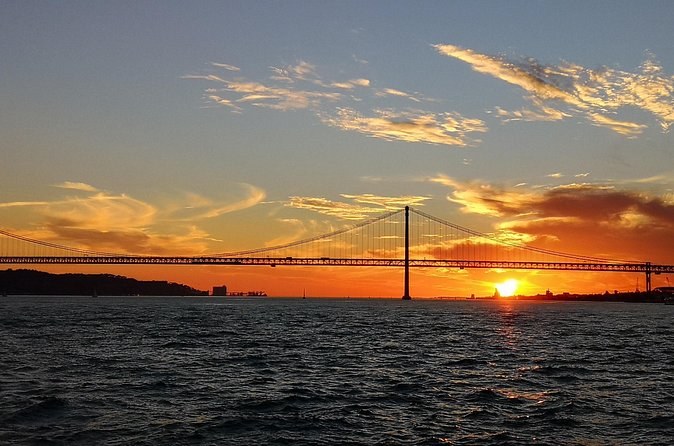
The short answer. The river you sail on has a bridge that once carried a dictator's name, a Christ statue built to keep a wartime vow, a monument that began life as plaster, and a tower that was built standing in the water. These twelve facts are sourced, and every one is something you can see from the deck of a Tagus river sailing trip.
The bridge overhead
1. It was named after Salazar until 1974
The 25 de Abril Bridge opened on 6 August 1966 as the Salazar Bridge, after the dictator who ordered it built, according to Wikipedia. After the revolution of 25 April 1974 it was renamed for the date. You sail under the new name and the old history at once.
2. It is painted the same colour as the Golden Gate
Its paint is the same International Orange as San Francisco's Golden Gate Bridge, and it was built by the company that built the Bay Bridge there, Wikipedia records. The family resemblance is obvious from the water.
3. It carries trains under the cars
Infraestruturas de Portugal describes it as a bridge for both road and rail traffic. The rail deck was added below the road in 1999, so you may hear a train rumble overhead as you pass beneath.
4. It once set records
When it opened it had the longest main span in continental Europe and the world's deepest bridge foundation, according to Wikipedia. It was also the fifth-longest suspension bridge in the world, and the longest outside the United States. Tolls are charged only northbound, into the city.
The statue on the far bank
5. The Christ statue was a wartime vow
On 20 April 1940 Portugal's bishops, meeting at Fátima, vowed to raise a monument to the Sacred Heart over Lisbon if the country was spared the war, the sanctuary's own history records. The idea had come in 1934, when Lisbon's cardinal flew over Rio de Janeiro and saw its Christ the Redeemer. Cristo Rei was inaugurated on 17 May 1959 before about 300,000 people.
6. It stands 113 metres above the river
The monument is 110 metres tall, a 28-metre figure on an 82-metre pedestal, and it rises 113 metres above the river. About 40,000 tonnes of concrete went into it, and the figure was carved by hand more than 100 metres above the ground.
The monuments at Belém
7. The monument to the navigators began as plaster
The Padrão dos Descobrimentos was first put up in 1940 for the Portuguese World Exhibition, built of perishable materials with the figures moulded in gypsum. It was rebuilt in concrete and stone in 1960, for the 500th anniversary of Henry the Navigator's death, its own site records. It stands 56 metres high.
8. Thirty-two figures follow the prince up the ramps
Behind Henry, who is 9 metres tall, 32 figures from the age of the navigators climb the two sides: navigators, cartographers, missionaries, chroniclers and artists. From the water you see them in profile, like a crew on a ship's deck.
9. The tower was built off the bank
Museus e Monumentos de Portugal records that Belém Tower was built between 1514 and 1519 on a basalt outcrop some distance from the north bank of the river. UNESCO adds that it served to defend the port of Lisbon. Its stone is carved in the Manueline style of King Manuel I's reign, with ropes, knots and animals worked into the walls, a sailor's decoration for a sailor's fortress. UNESCO also notes it is also known as the Tower of St Vincent, the city's patron.
10. The monastery holds Vasco da Gama
King Manuel I founded the Jerónimos Monastery in 1496, and construction began in 1502. Turismo de Lisboa records that its church holds the tombs of Vasco da Gama and the poet Luís de Camões. UNESCO inscribed the monastery and the tower together as one World Heritage property in 1983.
The river itself
11. The summer wind has a name
The nortada is the north and north-west wind that dominates the Portuguese west coast in summer, and it often blows strongest in the afternoon, a University of Lisbon study in Finisterra notes. It is the wind that fills the sails on an evening sail, and the one that occasionally keeps them furled.
12. The ferries are going electric
Transtejo Soflusa, which runs the commuter ferries from Cais do Sodré to Cacilhas and other towns across the river, presented a fully electric fleet in September 2026 and calls it the world's largest electric operation on the Tagus. Those are the ferries you see crossing ahead of your boat.
| Fact | Source | Year |
|---|---|---|
| Bridge opens as the Salazar Bridge | Wikipedia | 1966 |
| Rail deck added | Wikipedia | 1999 |
| Christ statue inaugurated | The sanctuary | 1959 |
| Monument to the navigators rebuilt in stone | Its own site | 1960 |
| Tower on the basalt outcrop built | Museus e Monumentos | 1514-1519 |
| Monastery and tower inscribed | UNESCO | 1983 |
What no one can promise you
Dolphins are not a promise on any boat we list. And the tide changes the river more than most visitors expect: the one-hour sail from the Bom Sucesso marina sets its route by the tide and the wind on the day. The rest of what you pass, west to east, is on Lisbon from the river, and every dock is on the Lisbon sailing map.
- To see the monuments up close: spend an afternoon at Belém first; see things to do before and after a sail.
- To pick the month: read the best time for a sunset sail.
- To see it before you go: the photo gallery from the river.
Boats with someone to tell the story
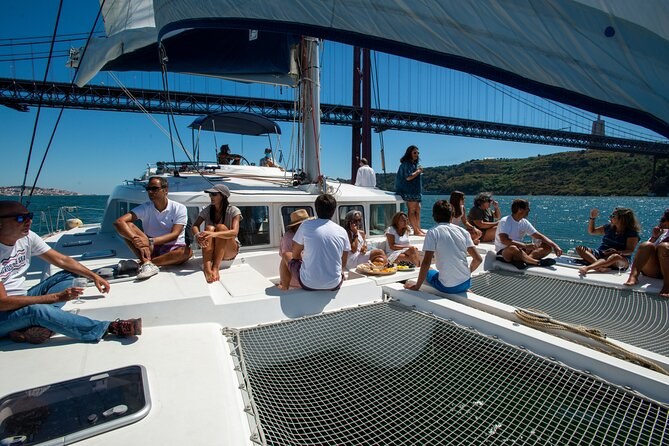
Lisbon Sailing Catamaran Public Cruise with drinks
Two hours on a sailing catamaran for up to 18 from Alcântara, with drinks, a live guide and a short pause off the riverside square downtown. Infant seats are available.
From $46 per person
Check Availability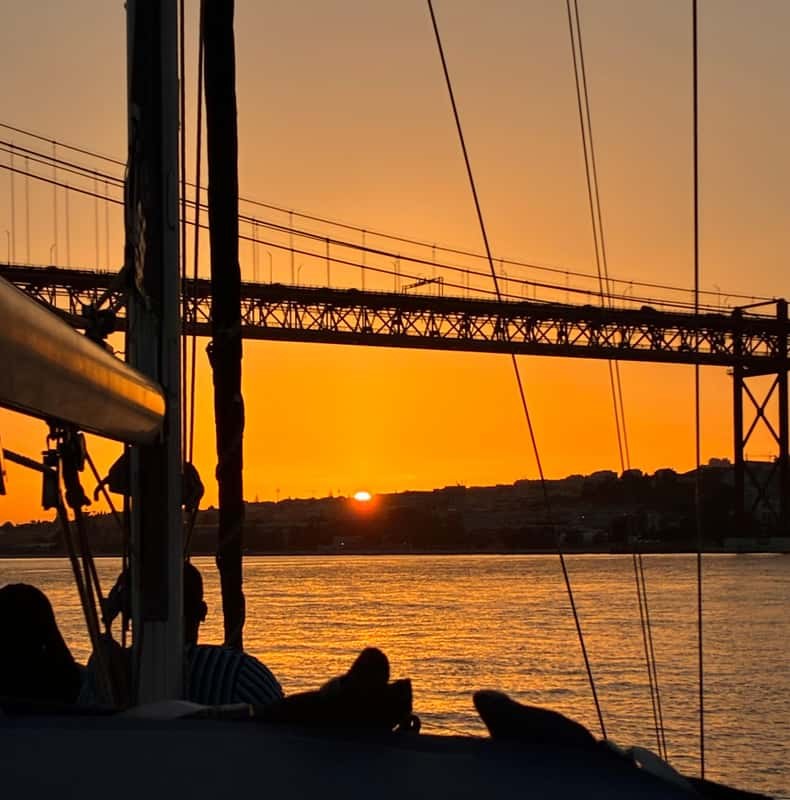
Sunset aboard a sailboat in Lisbon!
Two and a half hours on a ten-guest sailboat at sunset, with a skipper and a sailor who tell the city's stories, one drink, your own music and blankets when it turns cold.
From $34 per person
Check Availability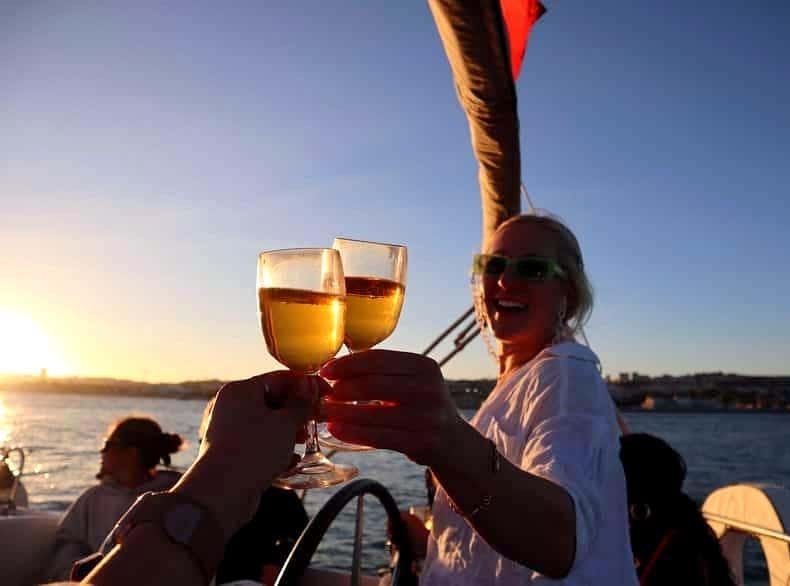
Lisbon Sunset Sailing – Small Group (max 10) Wine & History
Two hours on a ten-guest sailboat from Santo Amaro with white wine, port or soft drinks and a captain who tells the city's story; blankets and a toilet on board. Only the last departure of the day meets the sunset.
From $34 per person
Check AvailabilityNext: Pick a boat whose crew tell the river's stories, and see it all from the deck. Every fare sits side by side on Lisbon Sailing Tours.